
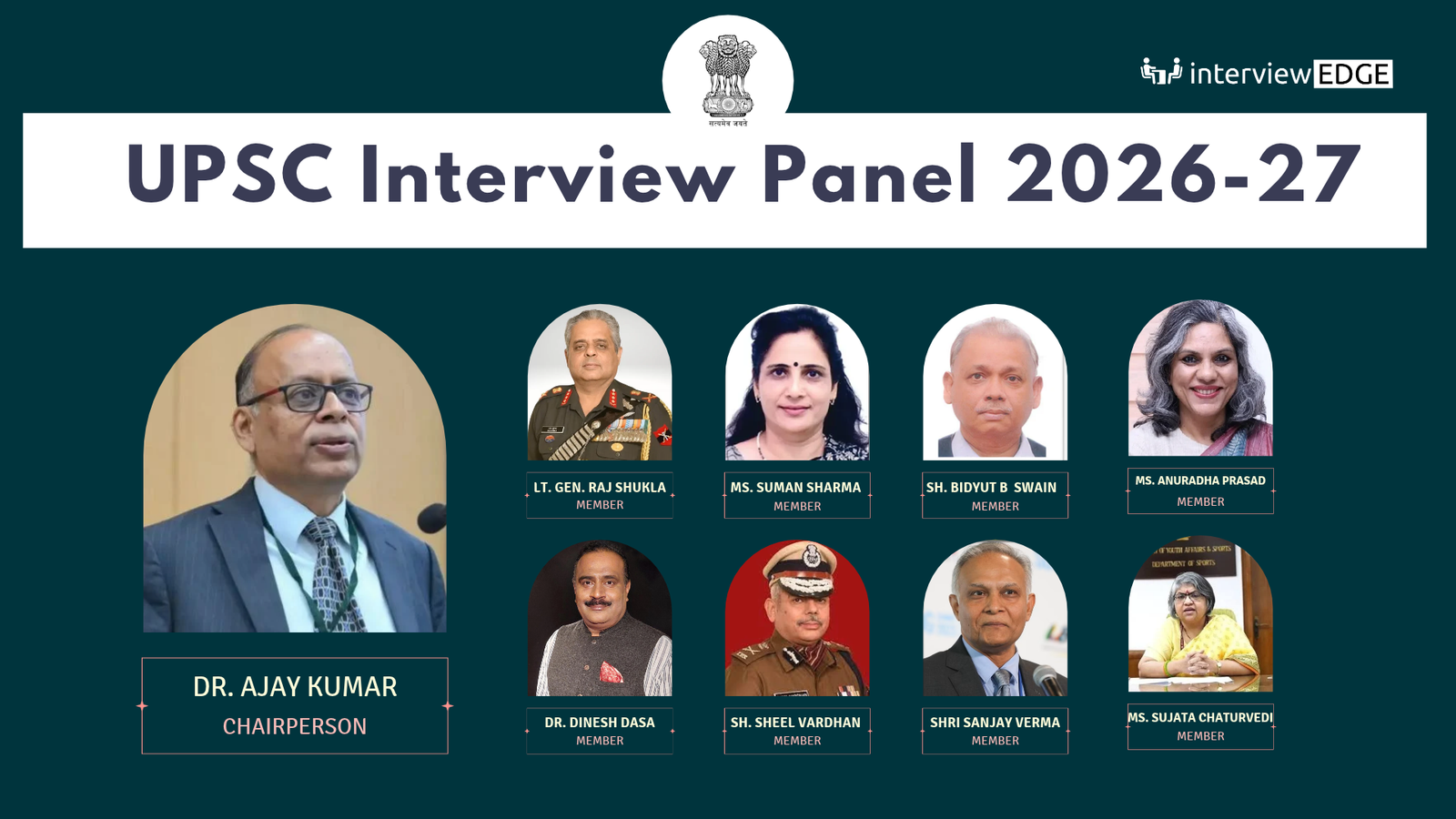
Walking into the UPSC Personality Test knowing a little about the people sitting across the table can be useful. Not because you can predict what they will ask, but because it gives you some context about the experience and perspectives represented on the panel.
The UPSC Commission has seen some important changes since our earlier panel profile was published. Dr. Ajay Kumar took over as Chairman in May 2025, and two new Members — Sujata Chaturvedi and Anuradha Prasad — also joined the Commission around the same time.
So, for candidates appearing for the UPSC Personality Test in 2026–27, here is a quick look at the present Commission.
Dr. Ajay Kumar – Chairman, UPSC
Dr. Ajay Kumar took charge as Chairman of UPSC on 15 May 2025. He is a 1985-batch IAS officer of the Kerala cadre and served as Defence Secretary from 2019 to 2022.
His academic background is also interesting. He studied Electrical Engineering at IIT Kanpur and later completed an M.S. in Applied Economics and a Ph.D. in Business Administration from the University of Minnesota.
Before becoming Defence Secretary, Dr. Kumar held several senior positions in the technology and electronics sectors, including senior roles in the Ministry of Electronics and Information Technology and as Director General of the National Informatics Centre. His career has therefore covered technology, digital governance, defence, industrial policy and public administration.
For candidates, his profile is a reminder that the UPSC interview can connect seemingly different subjects — technology and governance, defence and economics, innovation and public policy.
Lt. Gen. Raj Shukla (Retd.) – Member
Lt. Gen. Raj Shukla joined the Commission in July 2022. He is a former Indian Army officer who served as the General Officer Commanding-in-Chief of the Army Training Command (ARTRAC).
His career has been closely associated with military strategy, professional military education, technology and national security. He has also written and spoken extensively on strategic and security issues. He was awarded the Param Vishisht Seva Medal in 2021.
His background brings a strong defence and national-security perspective to the Commission. For candidates, areas such as military modernisation, hybrid warfare, emerging technologies, internal security and civil-military relations are worth understanding properly rather than preparing as isolated facts.
Ms. Suman Sharma – Member
Ms. Suman Sharma is a 1990-batch Indian Revenue Service officer and joined UPSC as a Member in May 2023.
Over a career spanning more than three decades, she has worked in areas including international taxation, transfer pricing, foreign trade and power trading. She also served as Additional Director General of Foreign Trade and was Managing Director of the Solar Energy Corporation of India (SECI). During her tenure at SECI, the organisation achieved Mini Ratna status.
Her professional experience covers taxation, commerce, renewable energy and economic policy.
For candidates, this is a good reminder to understand the connections between taxation, investment, trade, energy transition and economic growth rather than studying each subject separately.
Shri Bidyut Behari Swain – Member
Shri Bidyut Behari Swain is a 1988-batch IAS officer of the Gujarat cadre and joined UPSC in June 2023.
During his career, he served in several positions in Gujarat, including Industries Commissioner and Chief Electoral Officer. At the Centre, he worked in the Department of Commerce on areas including Special Economic Zones, trade negotiations and trade remedies. He later served as Secretary in the Ministry of Micro, Small and Medium Enterprises.
His experience covers administration, industry, trade, MSMEs and economic development.
For an interview candidate, subjects such as MSMEs, employment, exports, ease of doing business and India’s trade policy can therefore be useful areas to understand in depth.
Dr. Dinesh Dasa – Member
Dr. Dinesh Dasa joined UPSC in September 2023. Before that, he served as Chairman of the Gujarat Public Service Commission from 2016 to 2022.
He has an academic background in forestry and sustainable development, including a Ph.D. in Forest Laws and Sustainable Development from Gujarat National Law University and an M.Sc. in Forestry. During his tenure at the Gujarat Public Service Commission, he was also involved in discussions around recruitment systems and examination reforms across State Public Service Commissions.
His profile brings together public recruitment, examinations, governance, law and environmental issues.
For candidates, it is worth understanding not only what public service recruitment involves, but also the larger questions around examination reform, transparency, fairness and capacity-building in government.
Shri Sheel Vardhan Singh – Member
Shri Sheel Vardhan Singh joined UPSC in January 2024 after a long career in the Indian Police Service.
He served as Director General of the Central Industrial Security Force (CISF) from 2021 to 2023 and has extensive experience in intelligence, internal security and national-security policy. He has also worked on international security issues and served in India’s diplomatic mission in Dhaka.
His professional background covers policing, intelligence, critical infrastructure security and national security.
For candidates, this makes areas such as cyber security, organised crime, terrorism, border management, policing reforms and the changing nature of security particularly relevant to understand.
Shri Sanjay Verma – Member
Shri Sanjay Verma is a 1990-batch Indian Foreign Service officer who joined the Commission in February 2024.
His diplomatic career includes assignments as Ambassador to Spain and Andorra and Ambassador to Ethiopia, Djibouti and the African Union. He has also served as Consul General in Dubai and worked on China’s affairs, energy security and protocol at the Ministry of External Affairs.
He studied Economics at Mumbai University and holds a Master’s degree in International Studies from Jawaharlal Nehru University.
His career provides extensive exposure to diplomacy, international relations, trade, energy security and India’s engagement with different regions of the world.
For candidates, this is another reason to prepare international affairs through India’s interests and policy choices rather than simply memorising events.
Ms. Sujata Chaturvedi – Member
Ms. Sujata Chaturvedi joined UPSC in May 2025. She is a 1989-batch IAS officer of the Bihar cadre and served as Secretary, Department of Sports, Ministry of Youth Affairs and Sports before joining the Commission.
Her career has included senior positions in Bihar as well as the Government of India, including work in finance, urban development, the Department of Personnel and Training and UIDAI. As Sports Secretary, she was associated with initiatives including the Khelo India Games, the FIFA U-17 Women’s World Cup, the National Sports Repository System and efforts to strengthen India’s anti-doping framework.
Her experience covers public administration, finance, sports, youth affairs and governance.
For candidates, sports policy, public health, youth development, grassroots sports infrastructure and the role of the state in promoting sporting talent are all useful areas to understand.
Ms. Anuradha Prasad – Member
Ms. Anuradha Prasad joined UPSC in May 2025. She belongs to the 1986 batch of the Indian Defence Accounts Service.
She has more than three decades of experience across the Ministries of Defence, Finance, Food Processing Industries, Labour and Employment and Home Affairs. She served as Secretary of the Inter State Council Secretariat in the Ministry of Home Affairs, where her work involved Centre-State and inter-State relations. She also served after retirement as a Member of the Police Complaints Authority, Government of NCT Delhi.
Her background therefore covers public finance, Centre-State relations, administration, labour, policing and policy implementation.
For candidates, federalism, cooperative federalism, public finance and Centre-State relations are areas worth preparing with some depth.
Should You Try to Predict What a Member Will Ask?
This is where candidates should be careful.
Knowing the panel is useful. Trying to guess the exact questions of an individual Member is not.
A Member’s professional background may give you an idea of the range of issues they have worked on, but it does not mean that they will restrict their questions to those subjects. A candidate should be prepared for questions arising from the DAF, academic background, work experience, current affairs, hobbies and broader issues of national and international importance.
The panel is also not simply a collection of specialists asking specialist questions. The Personality Test is meant to assess the candidate’s suitability for a career in public service.
So, don’t walk into the interview thinking:
“This Member is from the Army, so I must prepare defence.”
Or:
“This Member is from the Revenue Service, so I must prepare taxation.”
Instead, use their backgrounds as an additional layer of preparation.
What Should You Know About the Panel?
You don’t need to memorise every posting, award or date from the Members’ careers.
Know the basics:
- Who they are.
- What they have done.
- What broad areas they have worked in.
- How those areas connect with current issues.
That is enough.
Finally, Don’t Overthink the Panel
The purpose of knowing the panel is to reduce uncertainty, not create more of it.
You do not need to enter the interview room wondering which Member will ask the first question or what a particular Member “likes”.
Prepare your DAF. Follow current affairs. Understand the issues you talk about. Know your academic and professional background. And most importantly, be ready to think aloud when the discussion takes an unexpected turn.
The panel may change. The questions may change. The issues may change.
Your ability to remain calm, honest and thoughtful is what stays relevant.
Prepare Smarter with Interview EDGE
Every UPSC candidate has a different DAF, background and interview journey. At Interview EDGE, we help you prepare accordingly with:
- Personalized DAF-based questions tailored to your education, work experience, hobbies and home state.
- Concise answer guidance to help you frame balanced, natural responses.
- Current affairs questions connected to your profile and the Personality Test.
- English and Hindi support so you can prepare in the language you are most comfortable with.
You can also explore the Interview EDGE repository of previous year questions to understand the range and depth of discussions that can arise in the UPSC Personality Test.
Good luck to all the upcoming candidates! You’re about to begin an incredible journey. Give it your best, enjoy the process, and remember that the experience will stay with you, whatever the outcome.